Sunday, January 27, 2013

A New Love and a Penzeys Surprise


Every year it’s the same for holiday and birthday gifts. I drop hints all year – not too subtle, either. “Here is a great gift idea if you can’t think of something,” I say and he nods. Then there is some panic as the date nears and he admits, “I just can’t think of anything for you,” until I write it down and hand it to him, often with a coupon or at least a picture.
This year before Christmas, I just printed out some pages with photos and locations, or clipped-out catalog illustrations, of things that I wouldn’t mind having. “Just choose something and keep the rest for the future,” I said.
And so it was that on Christmas I was “surprised” with a Food Saver, something I have been pointing out at Costco every time we walked past for the last three years or so.
Shortly after Christmas, we had a friend stay a couple of days and I cooked a batch of chicken picatta, making extra to freeze for future meals. I decided to try out the new Food Saver and since our friend said that he and his wife had used them for years, I asked for a demo. (I’m much more of a hands-on learner than trying to do something from a manual.) It was really so simple. He and Gary went off on an errand and I stayed at the kitchen counter, madly sucking air out of the packages. In fact I kept looking for more stuff until the cat hid under the bed!
Our friend was so impressed with the unit that when he got home they went right out and bought a new one to replace their 15-year-old relic.
This is one gadget that will save food AND money in the long run!

AN ADVENTURE in SURPRISE

I admit to being a sneak thief. Yup, and from my daughter even. When she stayed with us for a while when moving from the Great Lakes area to the West Coast she had her mail forwarded to our address. After she had gone she received a Penzeys spices catalog, and I found it so interesting and tore so many recipes out of it that I didn’t tell her I had it. This went on for a couple of years. I figured “don’t ask, don’t tell” and unless she asked about it, she wasn’t missing it.
There aren’t any Penzeys shops in Eugene – in fact, I was unaware that they have open shops until we spent a few days in Portland a while back. While we were waiting for our son to have his lunch break so he could join us, we took a walk around the NW area where he works, visiting some of the galleries. As we crossed a street I looked down the side street, spotted the Penzeys sign on a store front, and stopped cold when I reached the other side.
“What is it?” he asked.
“Look!! A Penzeys I said.”
“What’s that?”
I explained. “Well, let’s go take a look,” he said.
“It’s dangerous,” I told him. “Very.”
“Oh, let’s just go,” he replied, taking my arm. Of course I went willingly.
The moment we entered the store though, he said “Oh no!” (Well, he said something stronger but that conveys the idea.) It was quite large for a spices shop, with every Penzeys product in every size.
In fact, I had seen an offer for their new “Raspberry Enlightenment” that had caught my attention – anything raspberry catches my attention. Purchase a small amount – I think it was $15 – worth of other stuff and you could have it free. Of course, my coupon was in the catalog at home on the table since I didn’t expect to find a store.
I picked out a couple of things. Gary, who had been wandering around, came up to me with a grin on his face and handed me a recipe card for ginger cookies (there are lots of recipes around the store). When I went to pay, the proprietor asked if I had the coupon for the Raspberry stuff. I explained that it was at home, and about my theft of the catalog. “Oh – you can have one anyway,” he said, so I fetched a jar of it. Then I was a tad short on the purchase, and he forgave that, too. Nice place.
As for the Raspberry Enlightenment, it is touted as a great addition for meat, pasta, veggies – but I never get that far. It’s also great on English muffins, pancakes, and most especially on plain Greek yogurt. It takes so little to get so much flavor! They should have named it “Raspberry Intense.”
In our next phone conversation I fessed up to my daughter and she said dismissively, “Oh, no big deal, Mom. There’s a store close to where I live.” And here I was feeling guilty for two years.
I have my own subscription now and I’m still tearing out recipes, and enjoying my purchases. This month there is a free jar of cumin if you come into a store, but I’m not going 120 miles to get one. You may have a Penzeys near you though, and if so get acquainted with it! There is a world of flavors in there. And  Raspberry Essence…um, Intense…er, Enlightenment.

Monday, December 31, 2012

Cheesy Grits, and Oyster Stew on New Year's Eve


Speaking of fried grits – as we have done and will again – my daughter hosted Christmas for family and friends this year. To keep the pressure down, she and her daughters prepared some casserole dishes a day ahead, then heated a spiral ham and the casseroles on Christmas Day.
One of the casseroles was Cheesy Grits. Not only were they delicious that day (I had two helpings) but I brought some home and had fried cheesy grits for several breakfasts. Yum!!
The preserved lemons turned out great. I put some in jars and printed out a simple little cookbook of preserved lemon recipes and gave them as gifts. I saved some, of course, and have used them in salad dressing and in a bread pudding. Yum!! again.
New Year’s Eve rushes in as I write this, and I’m off to prepare our traditional oyster stew. Butter and half-and-half, chicken stock, oysters, sautéed green onions and a few herbs and spices. Rich and tasty. It’s no time to pull punches. Celebrate! Some steamed shumai on the side. Yum, yum, yum. Maybe finish the evening with hot buttered rum. Yum a rum rum, yummy. (No, I haven’t had a wee drop as yet.)
Recipe for cheesy grits:
One cup grits cooked according to box
1/2 lb of sharp cheddar cheese
2 to 3 cloves garlic squeezed
Dash each of Tabasco and Worcestershire sauce
1/2 stick of butter
Fold in two beaten egg whites after cooling
bake at 350 for about 1/2 hours
I can see adding sautéed onion, green chilies, green onions, variety of cheeses. 

HAPPY NEW YEAR with many more to come.

Saturday, December 22, 2012

Season’s Treatings


Being the season that it is, I have started making food treats for friends, family, and neighbors . Yesterday it was seasoned nuts and candy day.
I made two kinds of fudge, some chocolate truffles (I sneaked Craisins into them) as well as some spicy-seasoned roasted pecans and maple syrup sugared walnuts.
Here’s a tip: Do NOT wear a white sweatshirt while working with melted chocolate. Duh. ‘Nuff said.
SWEET AND SOUR NOTE
This morning I put the preserved lemons that have been pickling on the counter for the last month into the gifting jars. (I’ll make a little recipe booklet to go with them.) I found some very nice glass metal-ring-closure jars at the dollar store, the kind that snap over the edge. Pretty, and reusable.The plastic ones I had looked at earlier were $3.95. I got better for $1 each, but of course when I went back to look for more the stock had been wiped out.
I wasn’t sure about the lemons since this is the first time I have made and used any. They’re great! I’ll write more about them in future. They do make an attractive, tasty, and usual gift, not to mention enhancing some of the things you cook. 
THE FRUITCAKE ALTERNATIVE
Today it will be cookies. Chocolate chip pretty much meets universal approval (I’ll leave out the nuts in at least some of them for my un-nutty friends). Years ago I discovered that using the basic toll-house cookie dough recipe, but that mixing in candied fruit (a la fruitcake variety) and nuts (in some) instead of chocolate chips, makes a delightful and different-tasting cookie. I wowed some of my mid-western tradition-bound relatives with these years ago. I still have some Mexican spice and lavender cookies in the freezer. Need no more.
GET A GRIP
Here’s another tip that, when I told my husband, we both went “duhhh…” He had been looking for a flat rubber jar opener thingy the other day and I admitted that I probably had banished it the last time I cleaned out the drawer, along with several other seldom-used or useless implements. But then I saw a tip that recommended using rubber gloves if you have trouble gripping the jar and/or twisting the lid. Duh. I’ll  pick up a new “kitchen” pair at the store. Garden gloves would work fine too, and more attractive and easier to store in a drawer.  

IN ANY CASE, HAPPY HOLIDAYS WHATEVER YOU CELEBRATE, AND WISHING YOU A SWEET AND SAVORY NEW YEAR.


Wednesday, December 19, 2012

The Egg and I and You and the Little Red Hen


 Let’s talk about eggs for a minute. I’ll try to be brief, since this is one of my favorite subjects, and once I clamber onto my soapbox I can go on for a long time. With age and aches creeping up on me, it’s not so easy to get down from that box so I’ll be careful.

 If you have noticed, eggs have been absolved from health iissues. They are no more guilty of adding cholesterol to your system than is lettuce. It all depends on your genes .Why? Well, you have to understand the function of an egg a bit.

Within a hen’s body, the future eggs develop gradually, starting with a pin-head sized yolk. The yolks, suspended in the hen’s body like a cluster of grapes at the top of the oviduct, develop and increase in size gradually, so there will be a constant stream of fully developed eggs being laid. When a yolk reaches optimum size, it breaks free of the little sac of tissue that has been holding it, and starts its journey down the oviduct. 

At this point, it can be fertilized, with sperm deposited in the blastodisc (which, when fertilized, is called the blastoderm). That is thick spot on the yolk, which you can usually find by examining the yolk when the egg is broken over a saucer. If you don’t see it, place another saucer rim-to-rim on top of the first, and flip it over to examine the other side of the yolk.) You can tell if an egg has been fertilized only after it has been incubated for a short time, when bloody veins spread across it. If you find little blobs of gray-colored stuff in your egg, it’s only a drop of blood released when the yolk broke free at the start of this journey.

If you have wondered what the little white strings on the sides of a yolk might be, they are chelaza: spiral membranes that attach to a thin membrane at the top and bottom of the egg, and hold the yolk in the center of the egg while it continues to develop. It spirals down the oviduct, with the white (albumin) forming around it until in the final steps, the shell is formed around the whole business, and the egg is laid. 

So what is the albumin (egg white)? It’s a protective fluid formed around the yolk to protect it while the egg is developing. Albumin is about 90% water, with the other ten percent a mixture of proteins. Think of it basically as functioning like amniotic fluid. (Gotta love those egg whites!) Egg white is quite useful when whipped into foam for meringue, for example, or it is also used to make glair, a binder for paints with many industrial uses, and also used in apply gold to manuscripts.  
 

The yolk, on the other hand, provides most of the nutrients for the developing chick. A chicken egg is ready to hatch after about 21 days of incubation. Think what a powerhouse that yolk needs to be! Three weeks – and a golden glob becomes a live chick with feet, eyes, blood, bones, feathers, and all the other features we expect.  

So when eating an egg, 90 percent of the nutritious stuff comes from that yolk. Nutrition or uterine fluid – what will it be? 


BUYING EGGS: 

I try to buy free-range eggs from local farmers when I can. They are likely to be fresher than eggs kept in lockers in stores. Free-range hens have natural lives and the opportunity to consume bugs, minerals, and other material from the soil. There is no happier sound than a hen cruising through spring grass, sort of humming to herself in contentment as the sun warms her back. Ahhhh….. As well, her eggs are going to be fully nutritious as she picks up proteins and minerals from the ground. Her eggs will have strong shells and will store longer, too.  

Terms such as “cage free” and “nest free” simply mean that they are allowed out of cages, but not necessarily outside. Not as good as the above, but not as bad as battery hens, crammed into cages three to a cage, unable to move around much, the ends of their beaks cut off so that they don’t peck each other in frustration, their optimum feed ration doled out automatically each day. (Feed to product ratios are studied and applied to determine the highest yield per unit, hence the most profit – one reason that smaller hens, such as Leghorns, are used for egg laying. Same goes for broiler fryers, and we don’t want to think about how they are raised commercially.) Needless to say, battery hens are highly stressed and, although I have no proof of this, I suspect that their anguish and maddened frustration may release hormones or chemicals into their eggs that we don’t want to consume. At the very least, it is inhumane to support this kind of business. 

A “vegetarian-fed” hen can never be free-ranging. It’s unnatural, like trying to raise a vegetarian dog. It just does not make sense.
OK, enough of that.


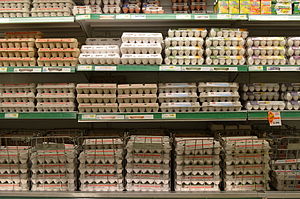
When purchasing a carton of eggs at a grocery store, make sure that all the eggs are in the carton point down. Eggs used to be sorted and packaged by hand, with care to place them point down. I’m pretty sure that most egg producers do this automatically with machines now, since so many eggs appear with points up in cartons. The problem is that many eggs these days are almost equally round on both ends and can fool machines. The human eye can tell the difference, though. The eggs to the right apper to be upside down!


How the egg is stored in the carton is important. The “fat” end of the egg contains an air pocket. As the egg deteriorates it releases moisture through the shell, and this air pocket forms between the shell and the membrane. The larger the air pocket, the older the egg, or if it breaks down the egg deteriorate faster. You know what it’s like to break an egg and have it slop out of the shell flat and runny. A fresh, properly stored egg from well-fed hens will stand right up in half-round position in the middle of the white.  

You can hold the egg to a strong light and actually see the air pocket on the end. Not that you could do this in a store, but if you are curious, give it a try at home. 

Thin, brittle shells are also a sign of poor nutrition. A hen needs lots of calcium, either from grazing the ground or from an additional calcium source – traditionally crushed oyster shell or even egg shells. Some feeds include calcium using a “scientific formula,” but I think it’s nicer to let a hen decide for herself what she needs. Her own body informs her when something is lacking.  

So – employ some common sense (whole eggs are nutritious) and some compassion (use free range eggs when possible, cage-free otherwise) and enjoy your eggs! I have one for breakfast just about every day. Unlike carbohydrates or less easily digested proteins, an egg can get me through to even a late lunch without growling (physically or mentally).

Friday, December 7, 2012

I Yam What I Yam with Raisins


So…I decided to enter a contest for cooking with raisins. I never have done such a thing, and the prize isn’t much, but now and then we need to stretch ourselves to try something new and different, right? Adds the spice to life, so to speak. So here is my first attempt. If nothing else, it’s a tasty dish and completely original.  Perfect side dish for the cold days of winter! Try it and enjoy.

I  Yam What I Yam with Raisins
Ingredients:
One to two deep orange yams, depending on size.
One medium yellow onion
One tart cooking apple
1-1/2 C dark raisins
about ½ C butter
Nutmeg, freshly grated if possible
Cinnamon, freshly grated if possible
salt and pepper

PREPARATION:
Heat oven to 350 

Use ½ of the butter to grease the sides of a 1-1/2 to 2 quart casserole dish (you won’t need to grease the bottom). 

Peel yams and slice about 1/8” thick. Try to find long narrow yams about 2” in diameter. If you have fatter yams, cut them in half lengthwise before slicing.
Peel onion and cut into thin slices.
Peel and core apple and cut into thin slices. 

COOKING METHOD:

Melt ½ of the butter in a small skillet. Add the onions, a sprinkle of salt and pepper, and cook slowly, stirring frequently, until onions are translucent. (Use a little more butter if necessary.) 

Place ½ of the onions in the bottom of the casserole.

Add ½ of the yams, overlapped in rows, on top of the onions.

Add a layer of apples, using all of the apple, overlapped in rows. Sprinkle with spices.

Top with a layer of raisins, about ¾ inch deep.

Repeat layers: onions, yams, spices, and a thinner layer of raisins.  

Cover casserole dish and bake in a 350 degree oven until yams are fork tender, about 45 minutes.


Sunday, November 11, 2012

The Old Black Cookbook


Cookbooks cram my kitchen bookcase. The titles change constantly as I replace old volumes with examples that reflect my current culinary interests. But standing tall between newer, more colorful covers is a shabby, spineless, stained, and tattered old volume known in the family as “the old black cookbook.” It is the one thing my oldest daughter, Robin, asked for when she got married. It is the one thing I had to deny her, although I later found a copy in an antique store and sent it to her.

It took a while for me to figure out why I couldn’t part with it. My mother had given me the cookbook when I got married. Officially titled the Good Housekeeping Cook Book, it had taught me most of what I knew about cooking. I could flip it open to any topic without referring to the index. Many of its recipes were old favorites. But my attachment went deeper than that. Family memories, I realized, were stuck to its pages with fruit juice and shortening and sugar, more evocative than any album of photographs. The cookbook was a twenty-five-year chronicle of our lives. 
 

A dozen more years have passed, but the cookbook is still on the shelf. I slip it into my hands, and it falls open to pages that make me smile. Did I ever really need a recipe for pot roast or pork chops? In the earliest days of marriage, of course, we had little money for such luxuries. The festive recipes then included hamburger or chicken or fish, all terribly cheap. Daily fare most often featured rice or macaroni or cheese. A quick flip to the cheese pages, and I am transported to a time before children arrived, to a place far away: to a time and a place where these recipes for Welsh Rabbit and Cheese-Onion Pie were in constant use. And here is the old favorite “payday special” (meaning the day before payday) — Baked Cheese Pudding. I see my notations that halve the ingredients to make the recipe suitable for two.

I leap ahead a few pages and a decade of time, and I’m in “eggs” — a section that saw heavy use during the years that my younger daughter, Erin, raised chickens in 4H. Nearly every recipe on these pages is familiar, from Deviled Eggs to Eggs Divan, from Eggs Foo Young to omelets. I flip to the dessert section and find the recipes for eclairs and custards that saved us from total inundation not only by eggs, but by milk. Those were also the years that both girls raised dairy goats.

 The kitchen aromas of that period seem to waft from these pages: the sour scent of milk being made into cheese or yogurt; the sweet fruity smells of peaches, blackberries, strawberries, raspberries, or plums, bubbling into jams and jellies; pungent cinnamon and cloves in simmering apple butter; soups and rich stews fragrant with our home-grown tomatoes, corn, peas, snap beans, potatoes, onions, garlic, and herbs; the mouth-watering aroma of baking bread; the savory scent of the spicy ketchup I simmered on the stove all day, half-gone from “sampling” by the time it was done. The old black cookbook was often open on the counter, its pages dusted with flour or spattered with fruit. The pages of the pie section are among the most soiled and heavily used, a testimonial to holidays with memories encrusted in pumpkin and mince meat and apples. Among the cake recipes I find old birthdays, bake sales, grange dinners, potlucks, company meals.

Drop it, and the old black cookbook flops open at the cookie pages. I must have baked these brownies and chocolate chip cookies hundreds of times. My notes run alongside, doubling the ingredients. The page with the huge brown splot was Erin’s doing, a spill during her first experiments with baking.

Freezing, canning, carving, converting — I learned them all from this book, and passed what I learned to my daughters. And although I rarely refer to it these days, the old black cookbook has a permanent place on my shelves.

Baked Cheese Pudding

(from Good Housekeeping Cookbook: Holt, Rhinehart and Winston, 1955. Some ingredients have been changed - such as cheddar instead of processed (ugh) cheese)

[Note:  add chopped onion, bell pepper, dill, or parsley to taste.]

Heat oven to 325º
6 bread slices, cut into 1 ½” squares   
½ lb. cheddar cheese
3 eggs
½ t. salt
½ t. Paprika
1/4 t. dry or prepared mustard
2½ C. milk, or 1-1/4 C. evaporated milk plus 1-1/4 C. water
Few slices stuffed olives (optional)        

In greased 1 ½ quart casserole, arrange alternate layers of bread and cheese, ending with cheese. Beat eggs till frothy; stir in rest of ingredients; pour over cheese. Bake, uncovered, 1 hr. Makes 6 servings


Monday, November 5, 2012

The Keurig: a Report on a Change of Heart


OK, so I laughed at these things for a long time. An expensive machine to make a cup of coffee. Mostly my ridicule was over the cost of the little pre-filled portion packs that you had to buy for it. Expensive! I checked them out at the supermarket the other day and the cost came to about $1 a cup, although I’m sure that I have seen them cheaper elsewhere. 

But then I visited a couple of friends who had them. Fresh, hot coffee in a minute! (literally). I still thought it all a bit silly until one friend explained that you could buy a “K-cup filter” that you could fill with your own coffee. Less environmental impact from throwing away the commercial packets, less cost, more satisfaction from being able to use your favorite coffees.

I was watching sales, but most of the units on sale were for models that required the commercial packages. Then the other night Gary came home from his weekly hiking outing with a big grin on his face. He usually stops at Costco for a Polish dog for “supper” when the hike is over, and proceeds on to a local bookstore to check out magazines and new books. So it seems that he saw this Keurig on sale at Costco, with 60 “portion packs” included, and a nice rebate.

So when he came in with that grin and a look of excitement, he was holding something behind his back. “Do you believe in Santa Claus?” says he, and when I nodded expectantly he revealed the box with Keurig in it.
 
In a word, I love it! My usual routine had been to prepare the coffee maker at night, stumble into the kitchen in the morning and turn it on – feed the cat – return for coffee. And then throughout the day go back for another cup of the coffee that had already sat on the hotplate for two hours to “gain strength”  and reheat it.  Sometimes I reheated it a couple of times if I forgot to drink it. By late afternoon it resembled run-off from a street freshly surfaced with macadam but I didn’t want to make another pot, and it was too much trouble to boil water and pour through one of those little plastic things that sit on top of the cup (usually my cup runneth over when I do that.) 

Now it takes no more time to brew a fresh cup (one minute!) than it did to reheat one (1 minute 40 seconds) and the preparation time of filling the filter makes it about even – but so much more satisfying. I find I am drinking less coffee but enjoying it more.  

Of course, since my counter space is limited and my kitchen cupboards are full, I had to rearrange things a bit to make space for the Keurig. That meant removing a few appliances (including the old coffee-maker, which I’ll keep for gatherings) and the only place they could go would be the set of closets in the hallway – where I already keep things like the Dutch oven and the waffle maker. BUT of course, the hall closets were full. So I wound up cleaning out the closets, which was a chore I had already planned on doing (again). But then I had to find space for some of the closet contents. I moved the sheet sets that we use regularly, including pillow cases, to the cedar chest at the foot of the bed, where only some extra blankets and throws were stored. I eliminated five or six sets of old sheets – about 20 years worth – and donated them to St. Vinnie’s.   (They were fine: we had just found fabrics and colors that we preferred.)

After a day’s work (which involved some additional cleaning and rearranging) we were good to go! It has only been a couple of weeks, but we’re already comfortable with our routines. And the closet is tidy. No small feat!