If you have noticed, eggs have been absolved from health iissues. They are no more guilty of adding cholesterol to your system than is lettuce. It all depends on your genes .Why? Well, you have to
understand the function of an egg a bit.
Within
a hen’s body, the future eggs develop gradually, starting with a pin-head sized
yolk. The yolks, suspended in the hen’s body like a cluster of grapes at the
top of the oviduct, develop and increase in size gradually, so there will be a
constant stream of fully developed eggs being laid. When a yolk reaches optimum
size, it breaks free of the little sac of tissue that has been holding it, and
starts its journey down the oviduct.
 At
this point, it can be fertilized, with sperm deposited in the blastodisc
(which, when fertilized, is called the blastoderm). That is thick spot on the
yolk, which you can usually find by examining the yolk when the egg is broken
over a saucer. If you don’t see it, place another saucer rim-to-rim on top of
the first, and flip it over to examine the other side of the yolk.) You can
tell if an egg has been fertilized only after it has been incubated for a short
time, when bloody veins spread across it. If you find little blobs of
gray-colored stuff in your egg, it’s only a drop of blood released when the
yolk broke free at the start of this journey.
At
this point, it can be fertilized, with sperm deposited in the blastodisc
(which, when fertilized, is called the blastoderm). That is thick spot on the
yolk, which you can usually find by examining the yolk when the egg is broken
over a saucer. If you don’t see it, place another saucer rim-to-rim on top of
the first, and flip it over to examine the other side of the yolk.) You can
tell if an egg has been fertilized only after it has been incubated for a short
time, when bloody veins spread across it. If you find little blobs of
gray-colored stuff in your egg, it’s only a drop of blood released when the
yolk broke free at the start of this journey.
If
you have wondered what the little white strings on the sides of a yolk might
be, they are chelaza: spiral membranes that attach to a thin membrane at the
top and bottom of the egg, and hold the yolk in the center of the egg while it
continues to develop. It spirals down the oviduct, with the white (albumin) forming
around it until in the final steps, the shell is formed around the whole
business, and the egg is laid.
So
what is the albumin (egg white)? It’s a protective fluid formed around the yolk
to protect it while the egg is developing. Albumin is about 90% water, with the
other ten percent a mixture of proteins. Think of it basically as functioning
like amniotic fluid. (Gotta love those egg whites!) Egg white is quite useful
when whipped into foam for meringue, for example, or it is also used to make
glair, a binder for paints with many industrial uses, and also used in apply
gold to manuscripts.

The
yolk, on the other hand, provides most of the nutrients for the developing
chick. A chicken egg is ready to hatch after about 21 days of incubation. Think
what a powerhouse that yolk needs to be! Three weeks – and a golden glob
becomes a live chick with feet, eyes, blood, bones, feathers, and all the other
features we expect.
So
when eating an egg, 90 percent of the nutritious stuff comes from that yolk.
Nutrition or uterine fluid – what will it be?
BUYING EGGS:

I
try to buy free-range eggs from local farmers when I can. They are likely to be
fresher than eggs kept in lockers in stores. Free-range hens have natural lives
and the opportunity to consume bugs, minerals, and other material from the
soil. There is no happier sound than a hen cruising through spring grass, sort
of humming to herself in contentment as the sun warms her back. Ahhhh….. As
well, her eggs are going to be fully nutritious as she picks up proteins and
minerals from the ground. Her eggs will have strong shells and will store
longer, too.
Terms
such as “cage free” and “nest free” simply mean that they are allowed out of cages,
but not necessarily outside. Not as good as the above, but not as bad as
battery hens, crammed into cages three to a cage, unable to move around much,
the ends of their beaks cut off so that they don’t peck each other in
frustration, their optimum feed ration doled out automatically each day. (Feed
to product ratios are studied and applied to determine the highest yield per
unit, hence the most profit – one reason that smaller hens, such as Leghorns, are
used for egg laying. Same goes for broiler fryers, and we don’t want to think
about how they are raised commercially.) Needless to say, battery hens are
highly stressed and, although I have no proof of this, I suspect that their
anguish and maddened frustration may release hormones or chemicals into their
eggs that we don’t want to consume. At the very least, it is inhumane to
support this kind of business.
A
“vegetarian-fed” hen can never be free-ranging. It’s unnatural, like trying to
raise a vegetarian dog. It just does not make sense.

OK,
enough of that.
 When purchasing a carton of eggs at a grocery store, make sure
that all the eggs are in the carton point down. Eggs used to be sorted and
packaged by hand, with care to place them point down. I’m pretty sure that most
egg producers do this automatically with machines now, since so many eggs
appear with points up in cartons. The problem is that many eggs these days are
almost equally round on both ends and can fool machines. The human eye can tell
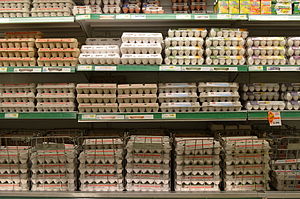
the difference, though. The eggs to the right apper to be upside down!
When purchasing a carton of eggs at a grocery store, make sure
that all the eggs are in the carton point down. Eggs used to be sorted and
packaged by hand, with care to place them point down. I’m pretty sure that most
egg producers do this automatically with machines now, since so many eggs
appear with points up in cartons. The problem is that many eggs these days are
almost equally round on both ends and can fool machines. The human eye can tell
the difference, though. The eggs to the right apper to be upside down!
How the egg is stored in the carton is important. The “fat” end of the egg contains an air pocket. As the egg deteriorates it releases moisture through the shell, and this air pocket forms between the shell and the membrane. The larger the air pocket, the older the egg, or if it breaks down the egg deteriorate faster. You know what it’s like to break an egg and have it slop out of the shell flat and runny. A fresh, properly stored egg from well-fed hens will stand right up in half-round position in the middle of the white.

You
can hold the egg to a strong light and actually see the air pocket on the end.
Not that you could do this in a store, but if you are curious, give it a try at
home.
Thin,
brittle shells are also a sign of poor nutrition. A hen needs lots of calcium,
either from grazing the ground or from an additional calcium source –
traditionally crushed oyster shell or even egg shells. Some feeds include
calcium using a “scientific formula,” but I think it’s nicer to let a hen
decide for herself what she needs. Her own body informs her when something is
lacking.

So
– employ some common sense (whole eggs are nutritious) and some compassion (use
free range eggs when possible, cage-free otherwise) and enjoy your eggs! I have
one for breakfast just about every day. Unlike carbohydrates or less easily
digested proteins, an egg can get me through to even a late lunch without
growling (physically or mentally).


